PLABEL WIN
Label design software for Windows: barcodes, GS1-128, QR and your own data
Draw the label once, link it to a database, a CSV or a JSON file, and print it on any Windows printer. PLABEL WIN 3.2 adds rich text formatting tags, keeps the full set of 1D symbologies, GS1-128, QR, DataMatrix and PDF417, and exports to PDF, PNG, JPEG or GIF.
Rich text: one text block, many formats
Rich text is a text element that understands inline formatting tags. Instead of stacking half a dozen separate texts to build a heading, a highlighted warning and a right-aligned total, you write a single block and let the tags do the work: bold, italic, underline, strikeout, font family, font size, text colour, background highlight and per-line alignment. The whole block can still be linked to a database field, so the formatting travels with your data.
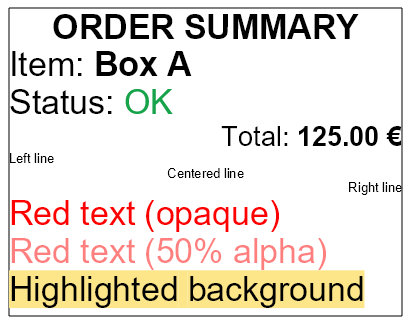
The example on the right is produced by this notation:
<C><B>ORDER SUMMARY</B></C><BR>
<L>Item: <B>Box A</B></L><BR>
<L>Status: <FC:16A34A>OK</FC></L><BR>
<R><FS:8000>Total: <B>125.00 €</B></FS></R>
<FS:3800>
<L>Left line</L><BR>
<C>Centered line</C><BR>
<R>Right line</R>
</FS>
<FC:FF0000>Red text (opaque)</FC>
<FC:80FF0000>Red text (50% alpha)</FC>
<BC:FFFDE68A>Highlighted background</BC>
Formatting tag reference
Colours accept 6 hex digits (RRGGBB, fully opaque) or 8 hex digits
(AARRGGBB), where the first pair is the alpha channel — so
<FC:80FF0000> is red at roughly 50 % opacity.
Rich text is an STD-only feature.
Intuitive and professional design
Create high-quality labels with an intuitive, revamped interface that lets you insert text, paragraphs, rich text, compound text, barcodes, images, predefined vector symbols and more. Customise every element with precision and connect your designs to existing data. Ideal for labelling storage boxes, marking clothes for laundry, cables and electronic connections, document classification, equipment inventory management, barcodes for stock, pricing and promotions, logistics and warehousing, QR codes for traceability, batch and expiry control, part marking, attendee badges and accreditations.
GS1-128: several pieces of data in one barcode
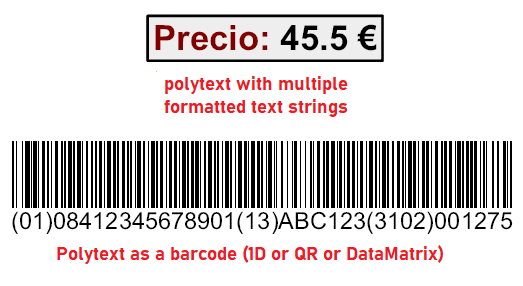
GS1-128 (formerly EAN-128) is the global standard that lets a single Code 128 barcode carry structured information — GTIN, batch, best-before date, net weight, serial number, pallet SSCC — each field introduced by its Application Identifier (AI). It is what makes a pallet or a case readable by any partner in the supply chain, and PLABEL WIN builds it for you.
How you build it
- Insert a compound text (polytext) element on the label.
- Add one line per piece of information; each line can be a fixed text or linked to a data field (database column, CSV/JSON field, counter or question).
- Enter the AI for each line and choose whether the identifier is displayed in parentheses in the human-readable text.
- Switch the element Type from formatted text to barcode — the same element can also be rendered as a QR or DataMatrix code.
- Pick the CODE128/EAN128 subset (A, B or C), the bar width in millimetres, the height, the checksum and whether the human-readable number is printed underneath.
Subset A covers ASCII 0–95 (control characters, digits, uppercase, symbols), subset B covers ASCII 32–127 (digits, upper and lower case, punctuation) and subset C encodes digit pairs 00–99, which is the densest option for numeric AIs.
QR, DataMatrix and PDF417
The three 2D symbologies share the same property panel, so once you know one you know them all: bar colour, background colour and whether it is filled, horizontal and vertical padding, alignment, rotation (0°, 90°, 180°, 270°), module size in millimetres (Bar Width), height, an optional Factor multiplier, and the code content — typed in directly or bound to a data field so every printed label carries its own value.
QR
The everyday 2D code: URLs, traceability links, batch and expiry data, event tickets and accreditations. Reads from any angle and survives partial damage, which makes it the safest choice when the label will be handled, folded or scanned with a phone.
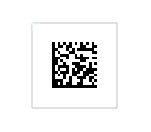
DataMatrix
The densest option for very small labels: it packs the same content into a fraction of the area, so it is the standard for part marking, electronic components, medical devices and pharmaceutical unit packs where there is barely any free surface.
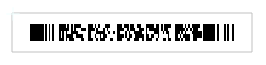
PDF417
A stacked linear code with a wide, low footprint and a large capacity. Typical of transport documents, identity and shipping labels, and anywhere a long text block has to travel inside the barcode itself.
QR, DataMatrix and PDF417 are STD-only features. The LITE version prints the full set of 1D symbologies.
Every 1D symbology you are likely to need
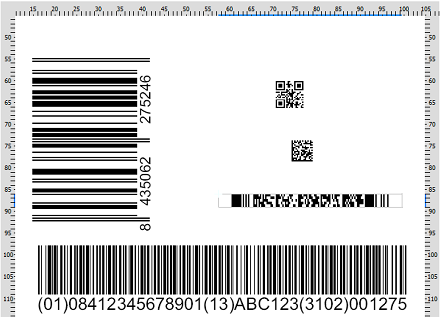
CODE39 and CODE39EX, CODE93 and CODE93EX, CODABAR, INTER_25, INDUS_25, MATRIX_25, CODE11, MSI, POSTNET, EAN8, EAN13, UPCA, UPCE0 and CODE128/EAN128 in subsets A, B and C. For each element you set the narrow bar width in millimetres, the wide/narrow ratio, the height, the rotation and whether the checksum is calculated for you — PLABEL WIN completes EAN and UPC check digits automatically and pads CODE128-C to an even number of digits.
Your data on the label: database, CSV and JSON
Any text, paragraph, rich text, compound text, barcode, 2D code or image element can be bound to a field. Tick Link Data in the label properties, choose the data source, and PLABEL WIN prints one label per record. If the source has an integer field you can use it as the repetitions column, so a record that needs six copies prints six labels.
Built-in SQLite database
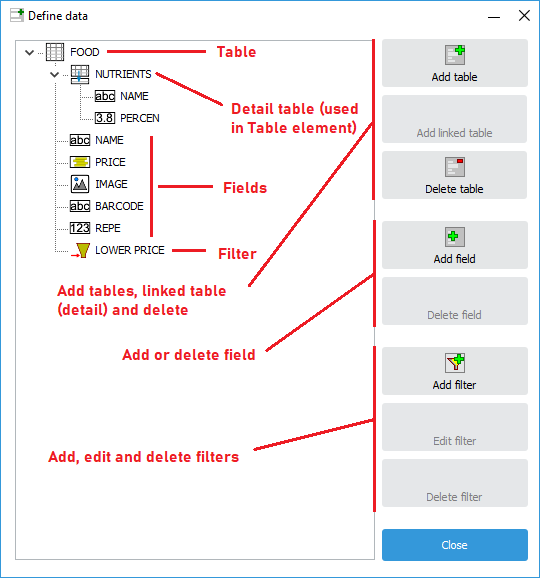
The installer ships a local SQLite database, so there is nothing to configure. From the program you create tables and add fields of type text (with length), integer, decimal, currency, date-time, paragraph, image and yes/no.
- Detail tables linked to a main table, used by the table element.
- Filters built from field + comparison operator, so you print only the records that match; the active filter is chosen in the editor.
- Formats per field —
#,##0.00 €for currency, date patterns for date-time — applied wherever the field is used. - Records are filled from the Fill Data editor, detail rows included.
Back up the database file regularly.
CSV files
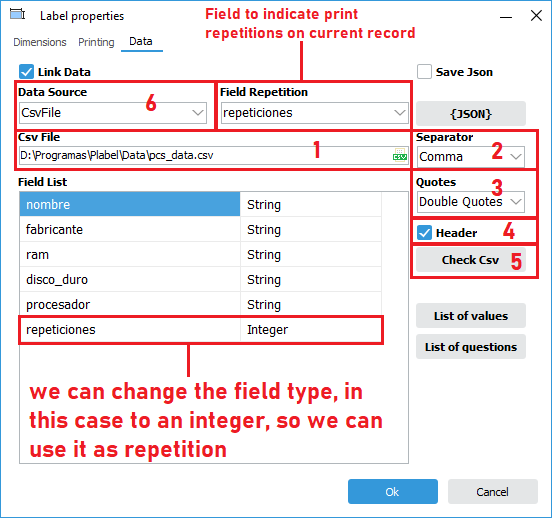
Point the label at a spreadsheet export and print it. In the Data tab you:
- Select the CSV file.
- Choose the separator used between values.
- Choose the quoting: single quotes, double quotes or none.
- State whether the file has a header row — recommended, because those names are what you pick from in each element.
- Press Check Csv to validate the settings, then select CsvFile as the data source.
Field types can be adjusted — set one to integer to use it as the repetitions column.
JSON files
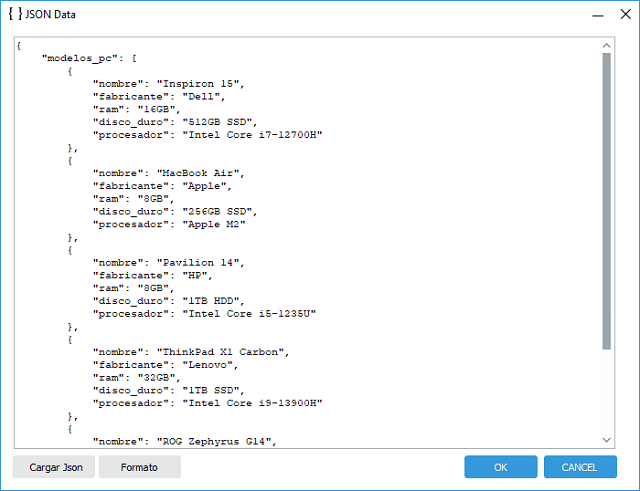
Ideal when the data comes from an API or another application. Press the {JSON} button to open the editor, then type, paste or load a file. The JSON must contain an array; its name is what you select as the data source, and its keys become the fields you bind to.
- Optionally save the JSON inside the label file, so the design travels with its data.
- A nested array inside each record works as a detail table for the table element — one label with a variable list of lines.
The table element
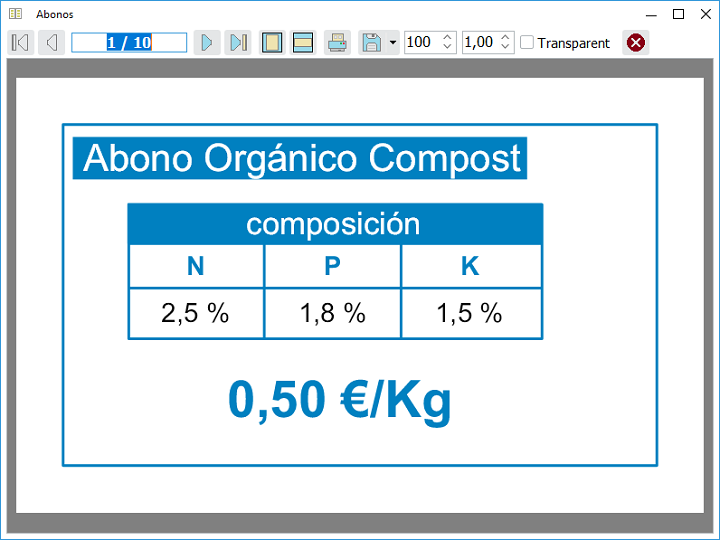
Prints the detail rows of the current record as columns and rows: a composition table, a list of components, a delivery breakdown. You define the title and its format, the column headers, the grid thickness and colours, and a footer with calculated values (sum, average and so on) formatted to your needs. The detail source can come from the database or from a nested JSON array.
No data source? Print series and ask at print time
- Counters — numeric series from a start value, a step and a limit, with a
prefix, a suffix and a numeric format (
0forces a digit,#leaves it blank).S-050-MO,S-051-MO,S-052-MO… - Lists of values — a named list of options; when you preview or print, PLABEL WIN asks which one to use.
- Questions and answers — a named prompt answered at print time as text, integer, decimal or date-time. Perfect for a batch number that changes on every run.
Filters restrict the printed records; the active filter is selected in the editor.
Key Features
Rich text formatting
Mix bold, italic, underline, strikeout, fonts, sizes, colours, highlights and per-line alignment inside a single text block using inline tags.
Barcodes and 2D codes
Fifteen 1D symbologies plus GS1-128 with application identifiers, and QR, DataMatrix and PDF417 for traceability.
Data connectivity
Built-in SQLite tables with detail tables and filters, plus CSV and JSON import, counters, value lists and print-time questions.
Specific graphic elements
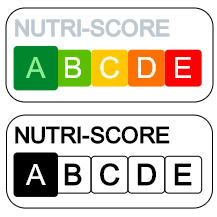
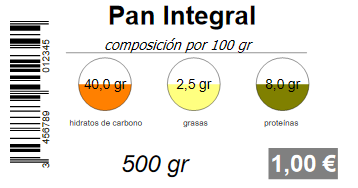
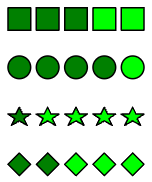
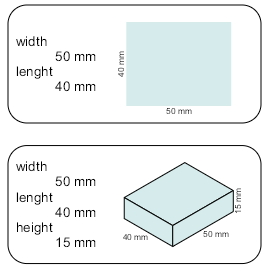
Nutriscore, percentage level indicators, ranking elements and a shipping-package dimensions indicator.
Preview before you waste a single label
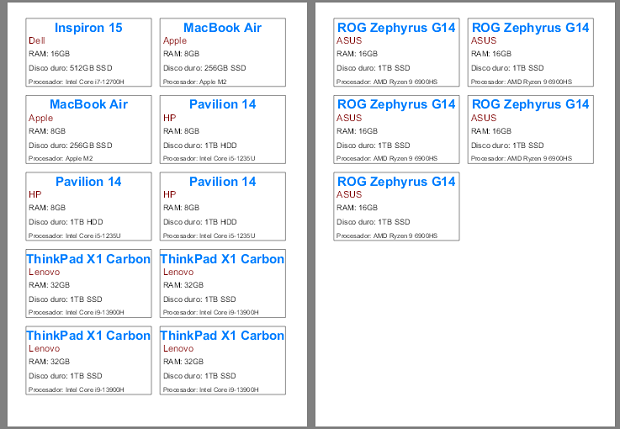
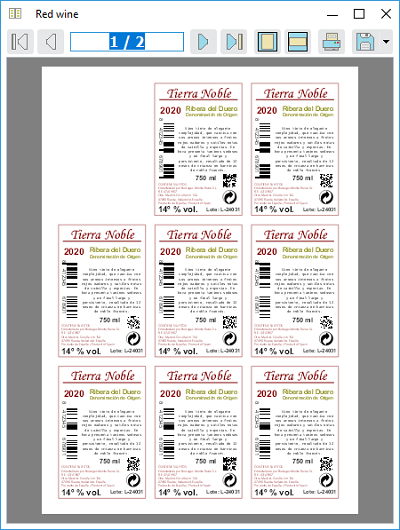
Adjust the row and column layout of the sheet, mark which label is printed first, set the number of labels and the print repetitions per label (when linked to a database, CSV or JSON), and work on continuous paper when you use an industrial roll printer. From the preview you can export the result as PDF, PNG, JPEG or GIF.
Specialised vector symbols
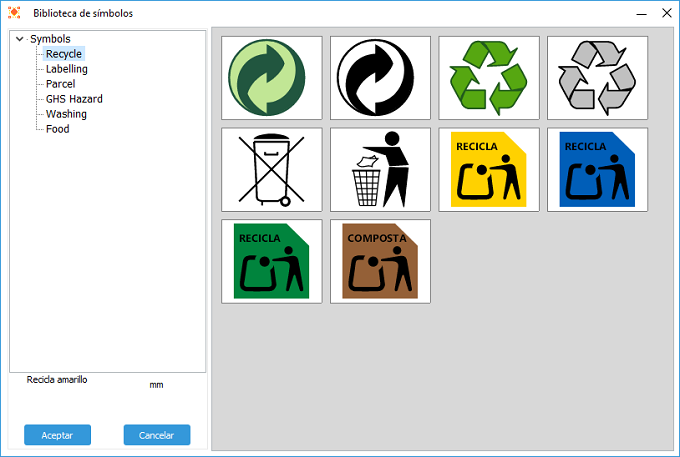
A library of vector symbols — scale and rotate them freely without losing quality — organised by family: recycling, labelling, parcel handling, GHS hazard, washing care and food. It includes a parametrisable Nutriscore, level indicators for nutritional values, ranking marks and a package dimensions element.
Graphic indicators
Four ready-made elements that would otherwise take a designer an afternoon.
Version Comparison
| Features | LITE | STD |
|---|---|---|
| Insert text | ✔ | ✔ |
| Rich text with formatting tags (new in 3.2) | ✘ | ✔ |
| Lines, polylines, and polygons | ✔ | ✔ |
| Extend, trim, and join lines | ✘ | ✔ |
| Circles and ellipses | ✔ | ✔ |
| Arcs | ✘ | ✔ |
| Paragraphs | ✔ | ✔ |
| Compound text / polytext (several texts with different formatting) | ✔ | ✔ |
| 1D barcodes and GS1-128 | ✔ | ✔ |
| Images | ✔ | ✔ |
| Local SQLite database, CSV and JSON data | ✔ | ✔ |
| QR codes | ✘ | ✔ |
| DataMatrix codes | ✘ | ✔ |
| PDF417 codes | ✘ | ✔ |
| Tables with detailed data | ✘ | ✔ |
| Predefined vector symbols | ✘ | ✔ |
| Nutriscore, level, ranking and package indicators | ✘ | ✔ |
| Export to PDF | ✘ | ✔ |
| Email support (1 year) | ✘ | ✔ |
Available Versions
LITE Version
Perfect for getting started
Free
- Design, preview and print
- 1D barcodes and GS1-128
- SQLite, CSV and JSON data
- No time limit
STD Version
All features included
79 €
- Everything in LITE
- Rich text formatting tags
- QR, DataMatrix and PDF417
- Vector symbols and indicators
- Table element with detail data
- PDF export
- One year of e-mail support
Secure checkout by Stripe. Promotion codes accepted on the checkout page. VAT is added where applicable.
One licence per computer. After payment you receive an e-mail from plabel@mesurasoft.com with the download link and your setup password.
PLABEL WIN 3.2 Documentation
Learn about the editor's possibilities and features in detail by consulting the version 3.2 user manual, including the full rich text tag reference and the barcode annex: